🎂 25% off all Brett Garsed books, sale already applied, no code necessary! 🎉




BOOK & VIDEO PACKAGE
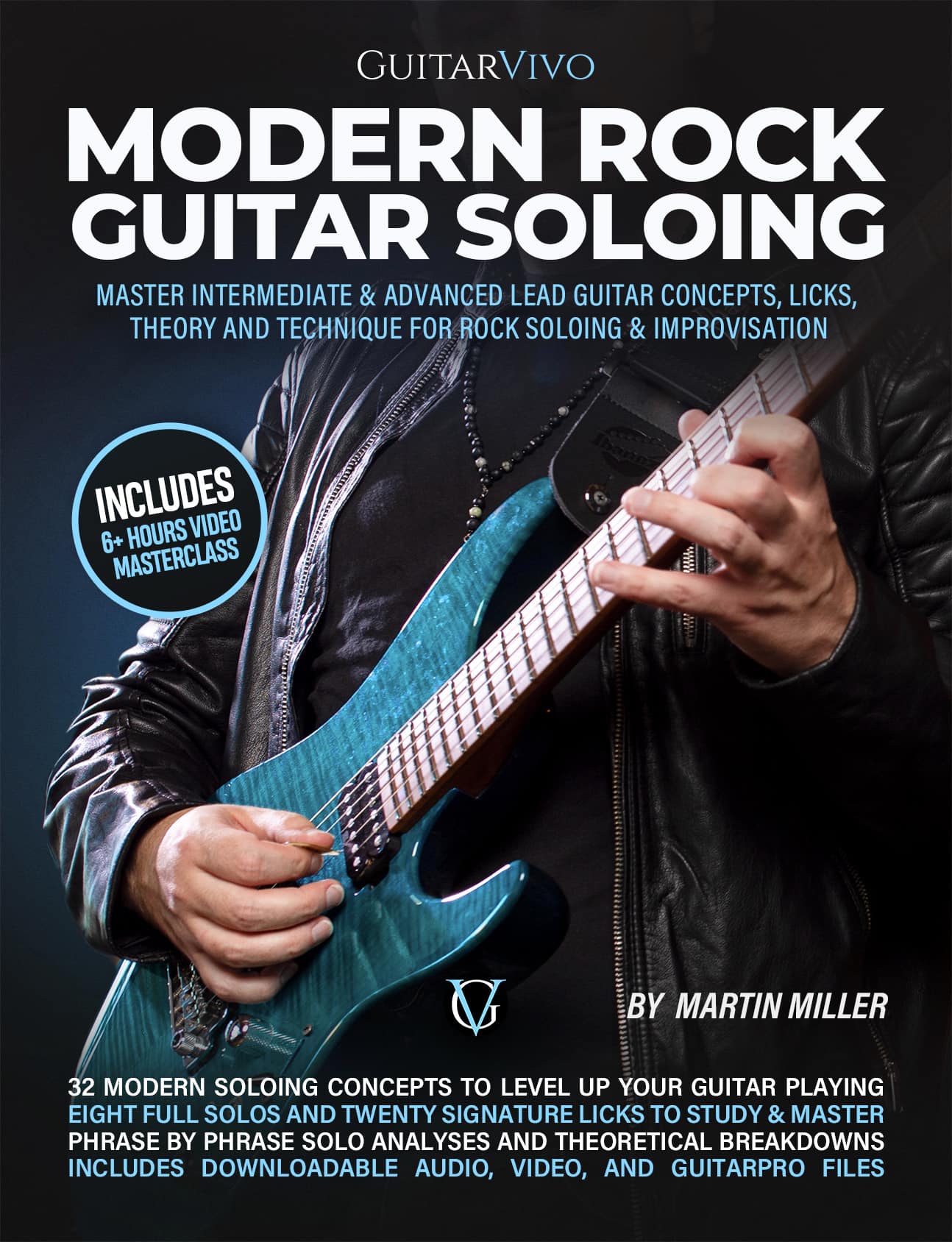
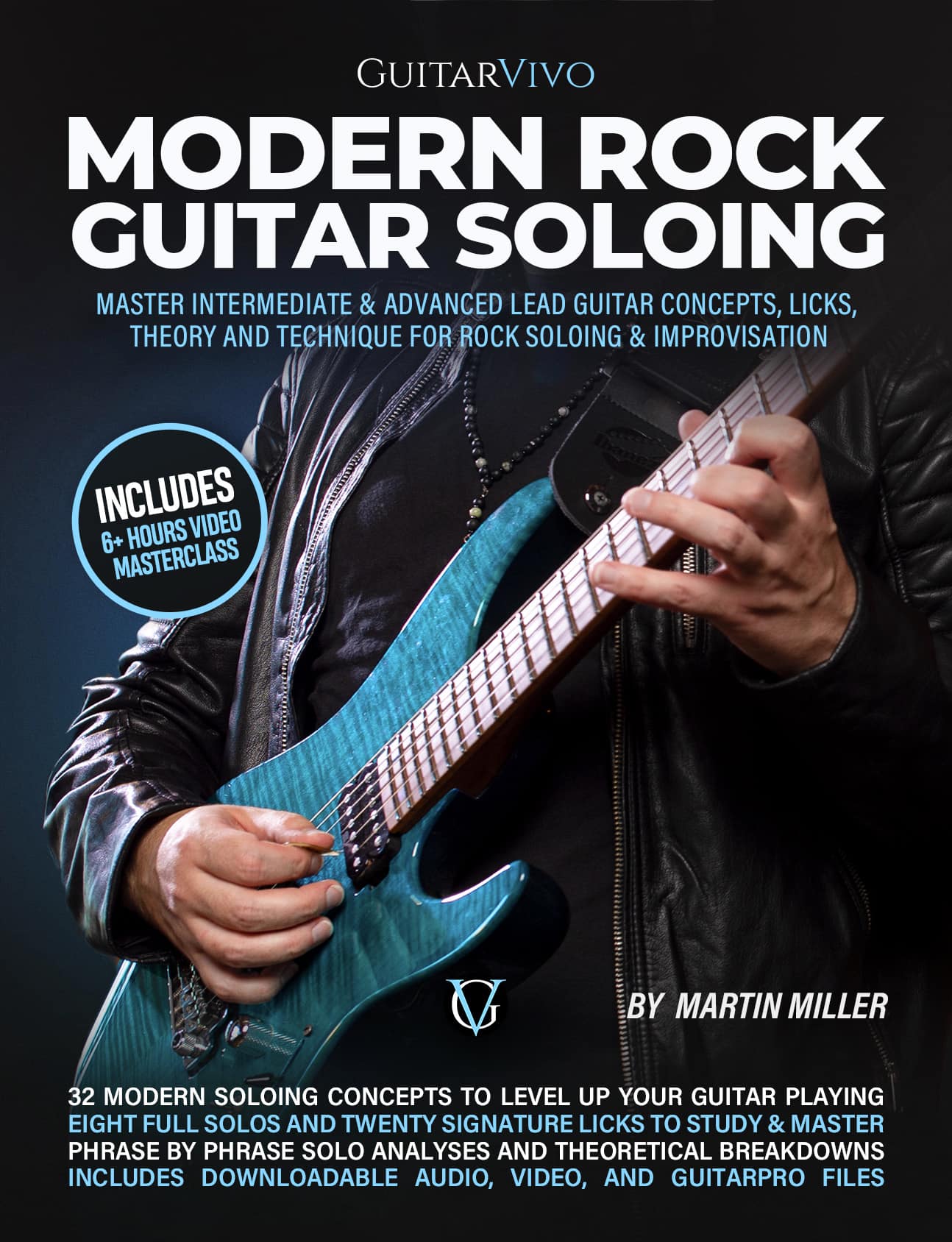
Modern Rock Guitar Soloing
By Martin Miller
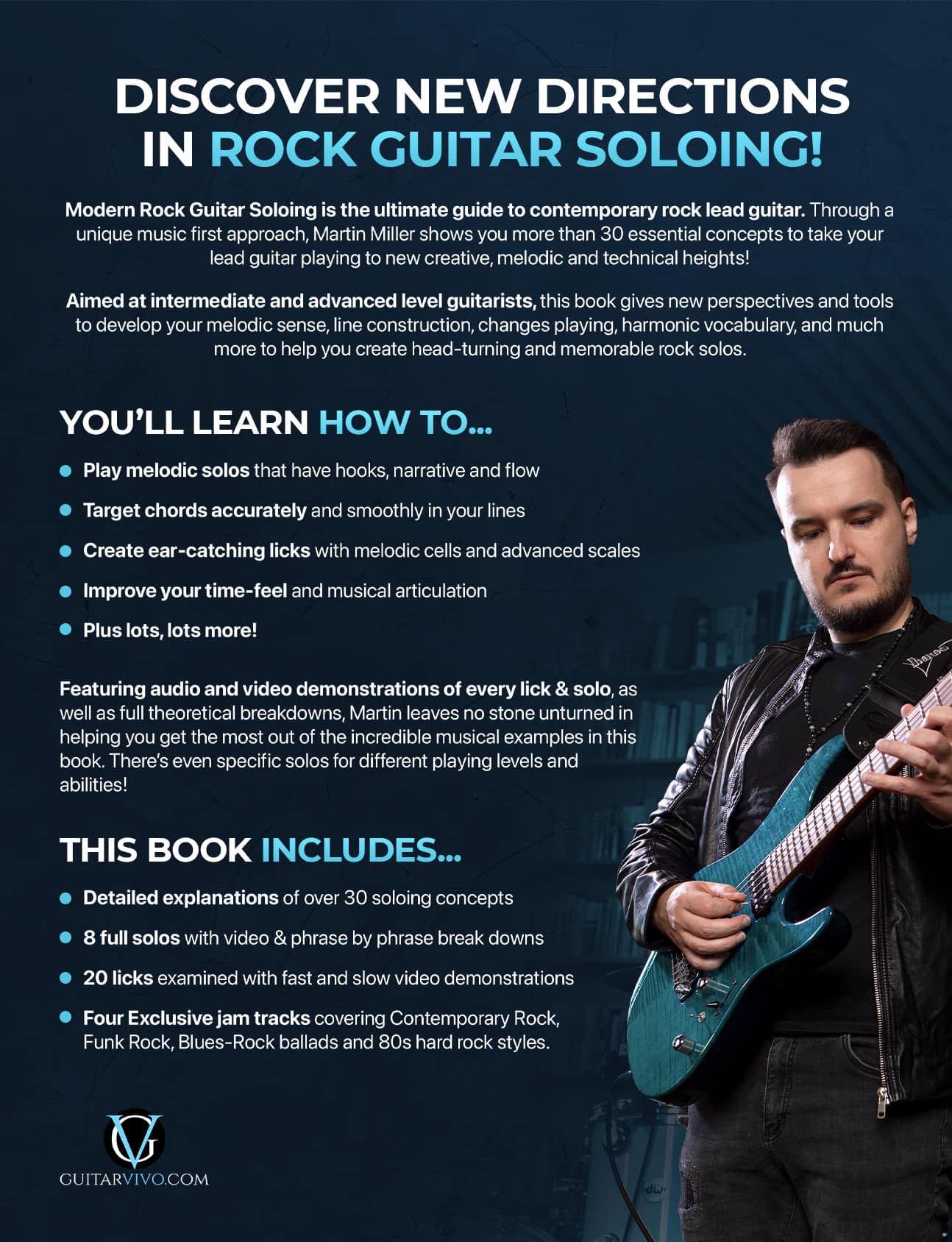
For intermediate & advanced guitarists ready to take their lead playing further. Martin doesn't just show you what to play, he shows you why it works. Learn the concepts, scales, and creative process behind his soloing, and develop a musical voice of your own.
$24.99
$24.99
Everything you get
Your complete soloing toolkit
More than a lick book — a complete method with theory, video demonstrations, and every tool you need to internalize why great solos work, not just how to play them.
140+ pages
Full tab & notation with detailed theoretical breakdowns for every concept, lick, and solo
50+ video files
Masterclasses, full solos, and fast & slow demonstrations for every lick
BONUS
6+ hour masterclass
Bonus video masterclasses from Martin with lifelong access
30+ progressive concepts
A structured, step-by-step path from foundational ideas to advanced techniques — nothing is left unexplained
Guitar Pro Files
Edit, loop, and slow down any example directly in Guitar Pro
Watch the introduction
See what's inside
Martin walks you through the book concepts, the licks, and the full solos, so you know exactly what you're getting.
A structured path to mastery
A musical method!
A step-by-step guide that takes you from foundational concepts all the way to full, performance-ready solos.
STEP 1
Learn
Master 30+ essential concepts — melodic line construction, chord targeting, rhythmic feel, harmonic vocabulary, articulation, and more. See exactly how Martin thinks when he improvises.
STEP 2
Internalize
20 signature licks – each applying the concepts directly. Watch fast & slow video demonstrations, then dig into the full theory breakdown behind every phrase.
STEP 3
Master
8 full solos with video and phrase-by-phrase breakdowns. Each comes in both intermediate and advanced versions across Contemporary Rock, Funk Rock, Blues-Rock Ballad, and 80s Hard Rock styles.
Stop learning solos. Start creating them!
Everything you need to develop your own voice as a rock guitarist.
What you'll learn
The ultimate guide to modern rock soloing
Solo construction
Play solos with hooks, narrative and flow
Harmonic vocabulary
Create ear-catching licks with advanced scales
Applied in 4 real styles
Exclusive jam tracks included
✨
Bonus: Over 6 hours of bonus video masterclasses included, lifelong access.
"Want to be a guitar god? Here's how!
More than just a book of tricks. This is an encyclopedia for budding vituoso guitar players. The written contents of this book along with its videos and backing tracks make this the best interactive guitar tuition book on the market.
It inspires you and creates endless possibilities with licks that can be played at any tempo and in any style and still sound fantastic."
Nicholas C.
Amazon Review
LOOK INSIDE
Take a peek inside the pages
Click any page to zoom in
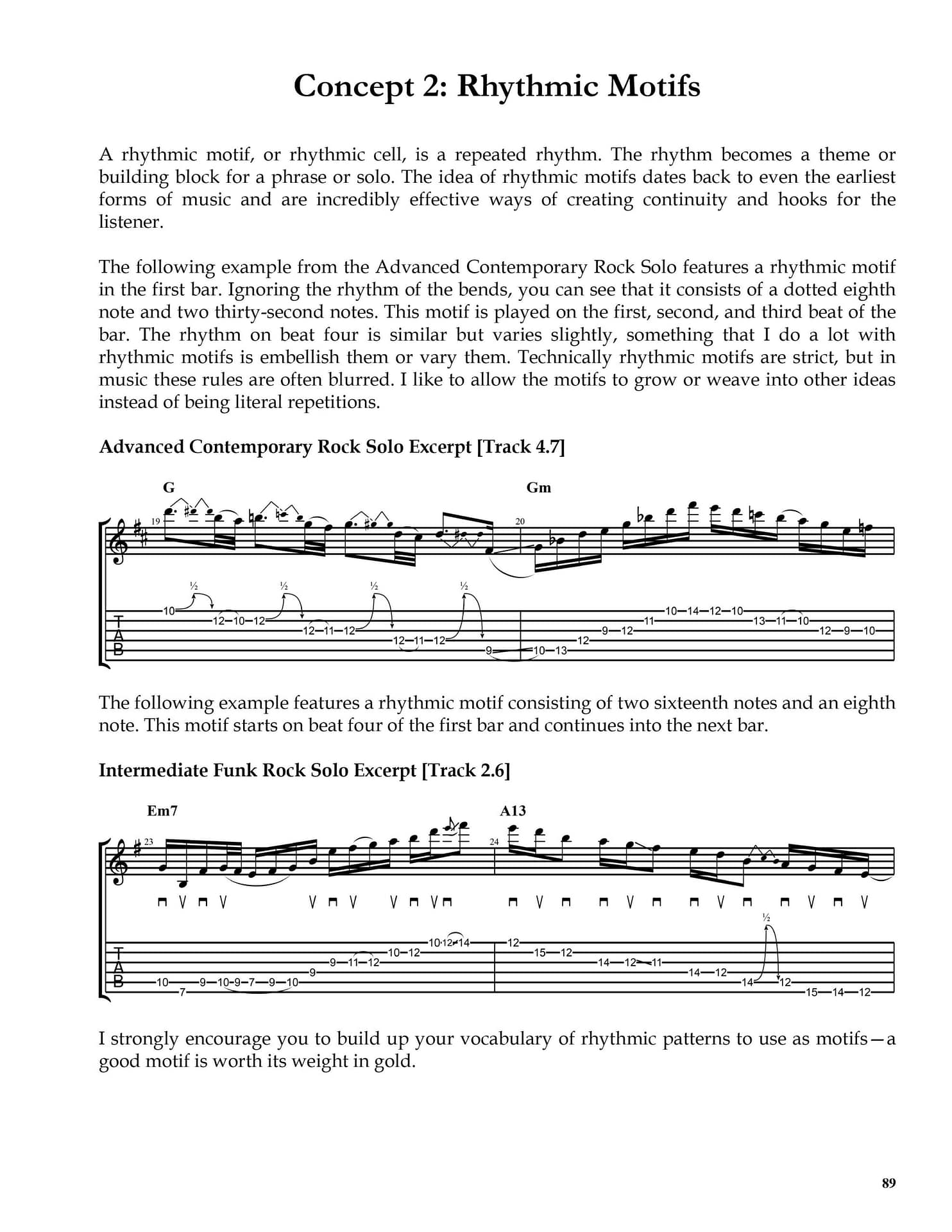
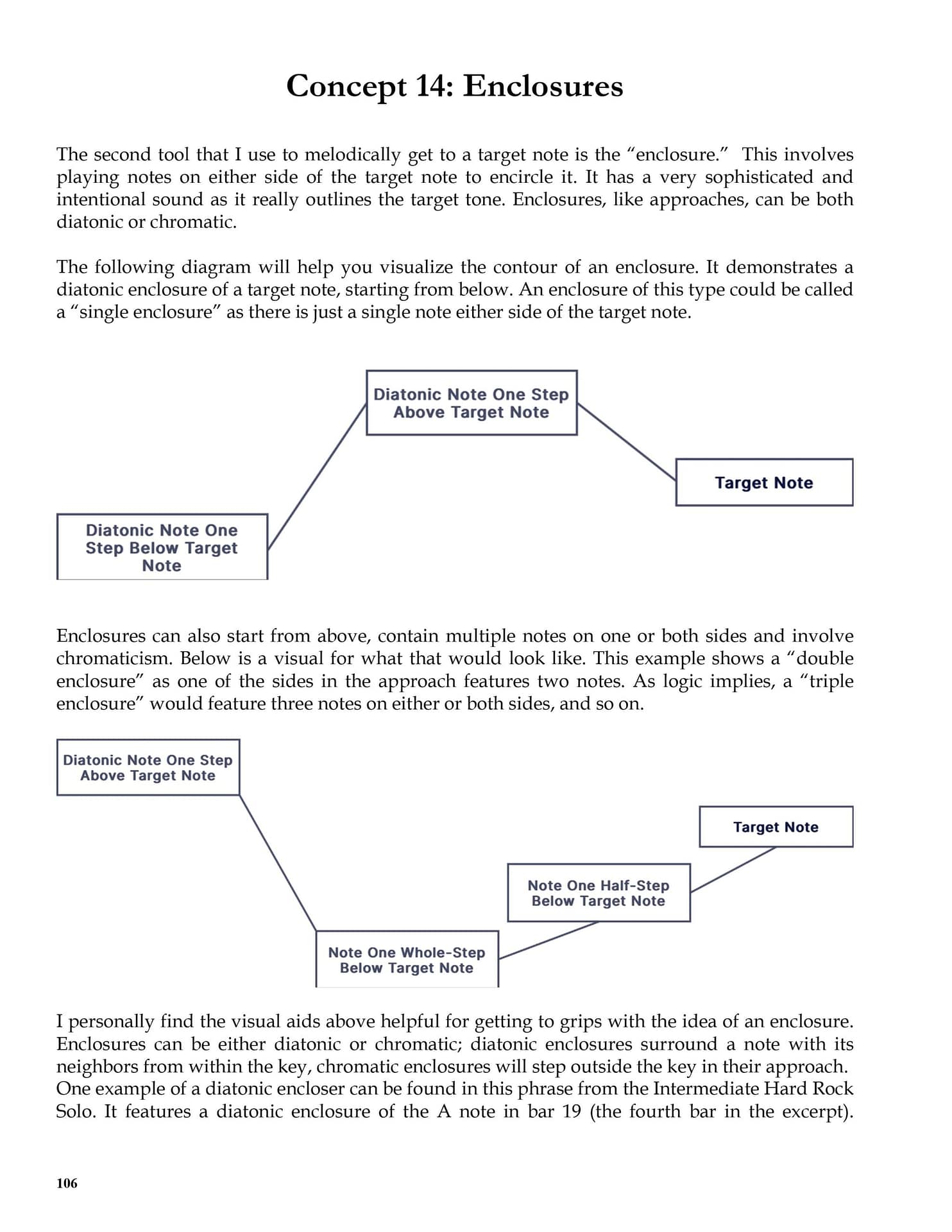
CHOOSE YOUR FORMAT
Available in PDF & Paperback
Both formats include all audio, video, Guitar Pro files, and bonus masterclass content.
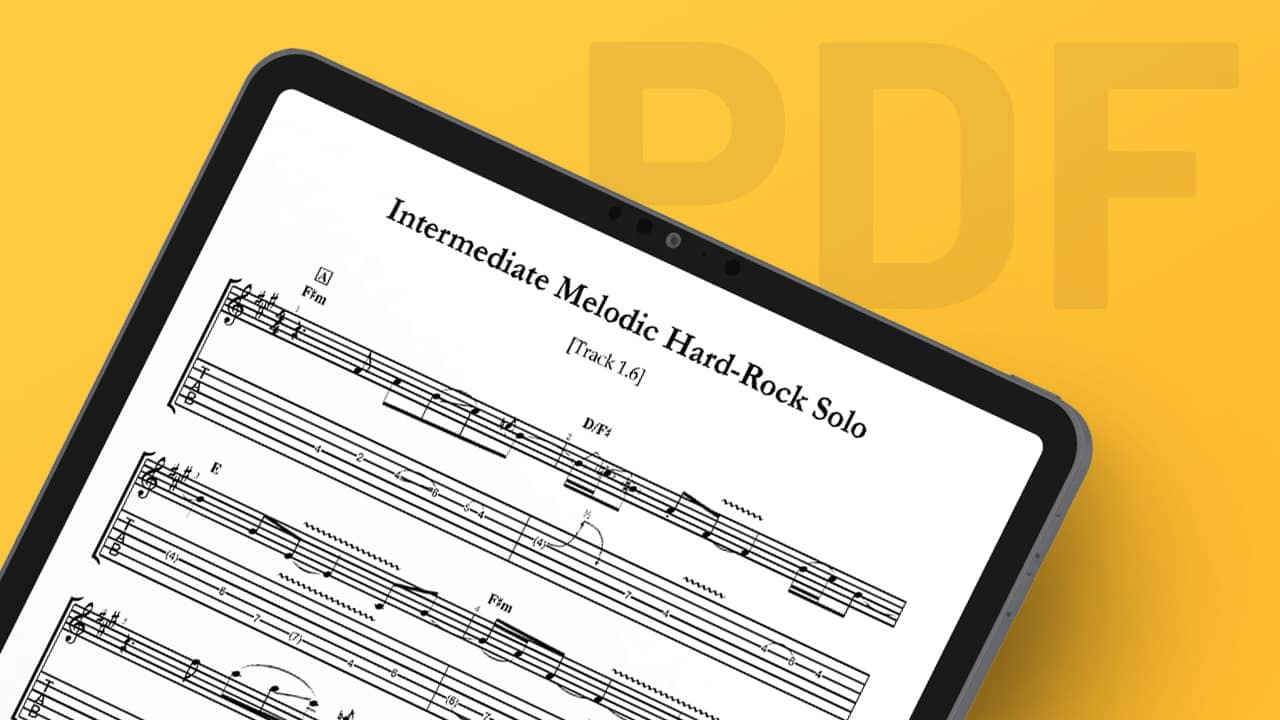
Digital PDF
- Instant download
- 146 page PDF
- 300+ audio & video files
- Guitar Pro files
- Masterclass replay
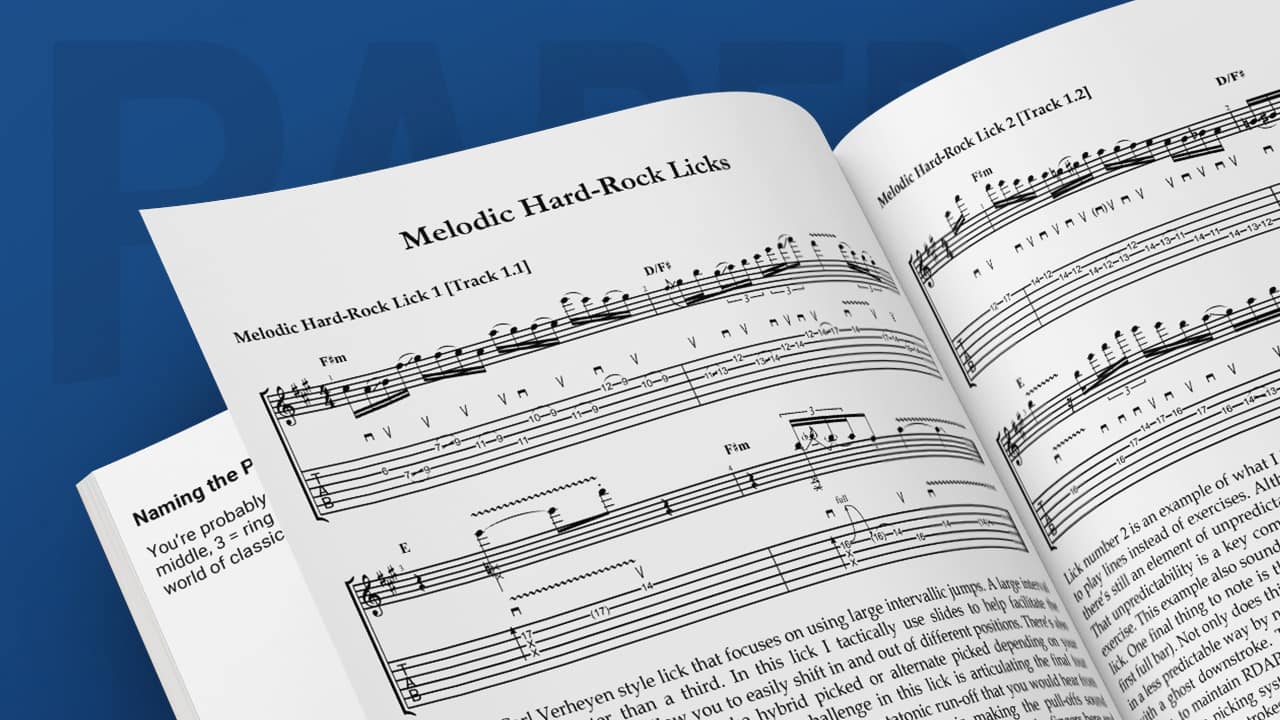
Paperback
- Ships via Amazon
- 146 page book
- 300+ audio & video files
- Guitar Pro files
- Masterclass replay
WHAT STUDENTS ARE SAYING
Verified Amazon reviews
for Modern Rock Guitar Soloing
Fantastic book for teaching intermediate electric guitar students
What I like most, as a guitar instructor, is how the licks are tasty enough that I steal them for my own playing quite often. These solos and exercises are crafted with impeccable taste. Often, licks have a pattern with nuance in articulation or melodic construction that makes it interesting.
R
Rob Howard
September 2, 2024

Really useful content and a huge bargain!
I really like the structure of this book. Clearly defined sections for each concept. The audio/video resources are of excellent quality and very helpful in mastering each solo or concept. The author is a world-class guitarist and many of the lines presented are unique and will work in a variety of musical situations. Highly recommended!
R
Lou DeMarco
April 8, 2024
Martin Miller is a Genius
This method book is the most comprehensive and logically organized book I've ever used. There is no fluff, all information is relevant and perfectly laid out. Coming from someone that's been teaching guitar for over 30 years, Martin is the best player out there right now. There is something for even the most proficient, professional players in this book.
R
Bryan M.
December 15, 2023
This book is a treasure trove for guitarists
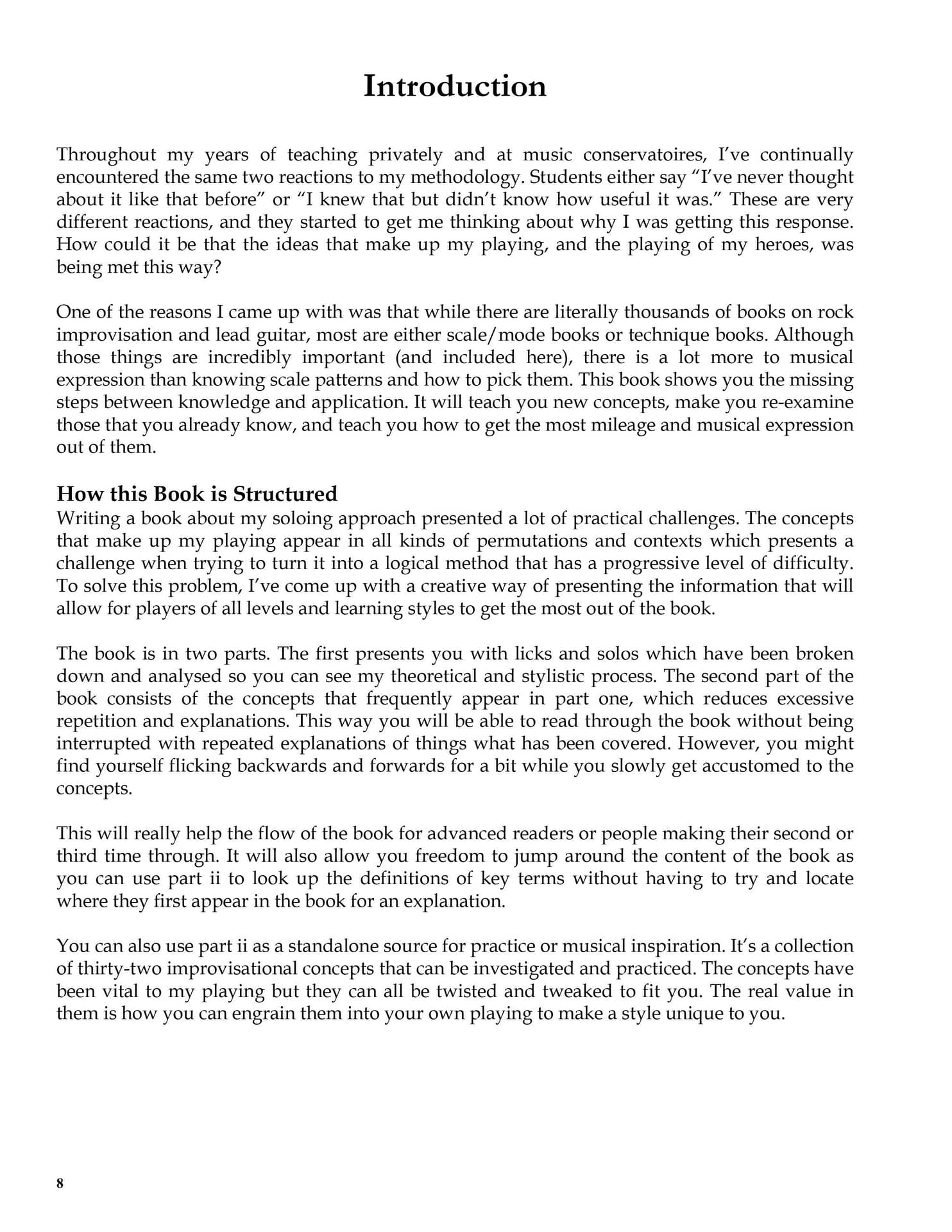
I wish more guitar tuition books were written and presented in this manner. Part 1 takes you on a guided tour through Martin Miller's thought process as he improvises. Full solos are broken down bar by bar. Part 2 acts as a repository of concepts to explore in your own way. This is the closest thing I've seen to private lessons in book form in 25 years of playing.
B
Mike Sanders
April 19, 2023
More than just a book… this is like getting a few books!
You get Martin Miller's approach to soloing in four different styles, 20 licks, 8 solos (intermediate & advanced versions), and a whole other part where Martin breaks down the concepts behind his lead guitar soloing. Part two could have been a standalone book and it would have still been worthwhile.
C
Az Samad
February 19, 2023
The best book on lead guitar playing on the market
One of the most remarkable things about this book is the way Martin Miller showcases his teaching ability. More than just exercises, this book dives into the thought processes and techniques that go into lead playing. When this book says it provides more than 6 hours of masterclasses, it means it. There is simply no better opportunity to learn from a modern expert of the instrument.
O
Timothy Larry
April 23, 2023
FULL BREAKDOWN
Course Overview
Get a closer look at the curriculum, chapter by chapter.
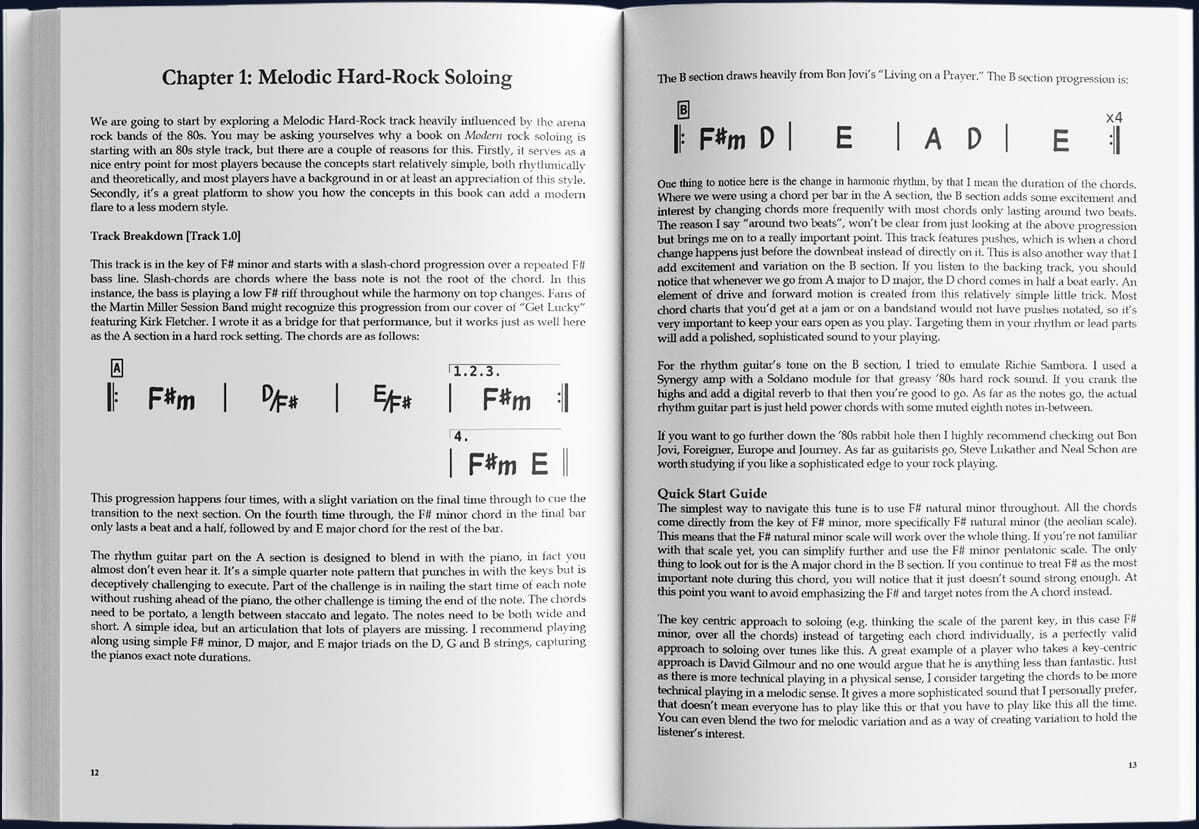
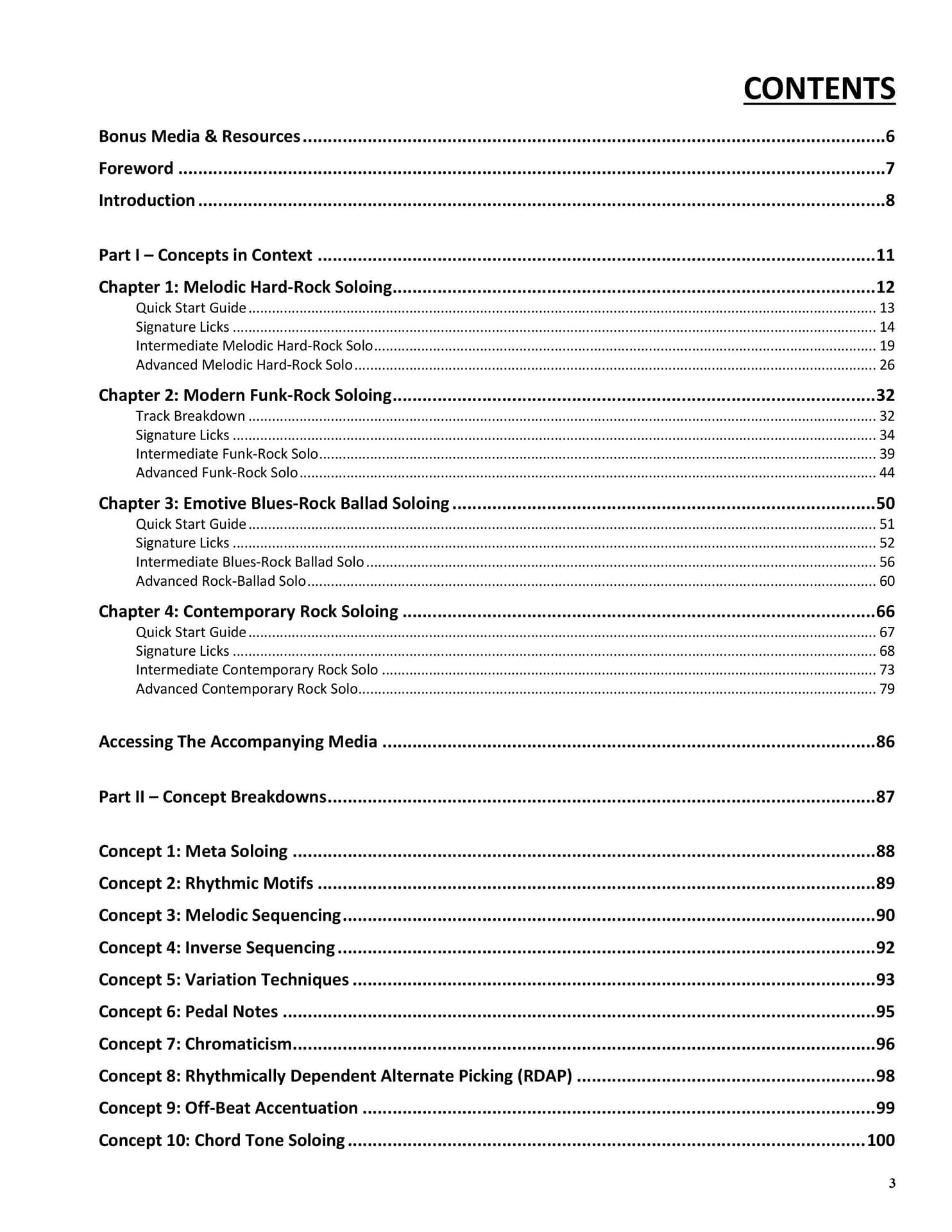
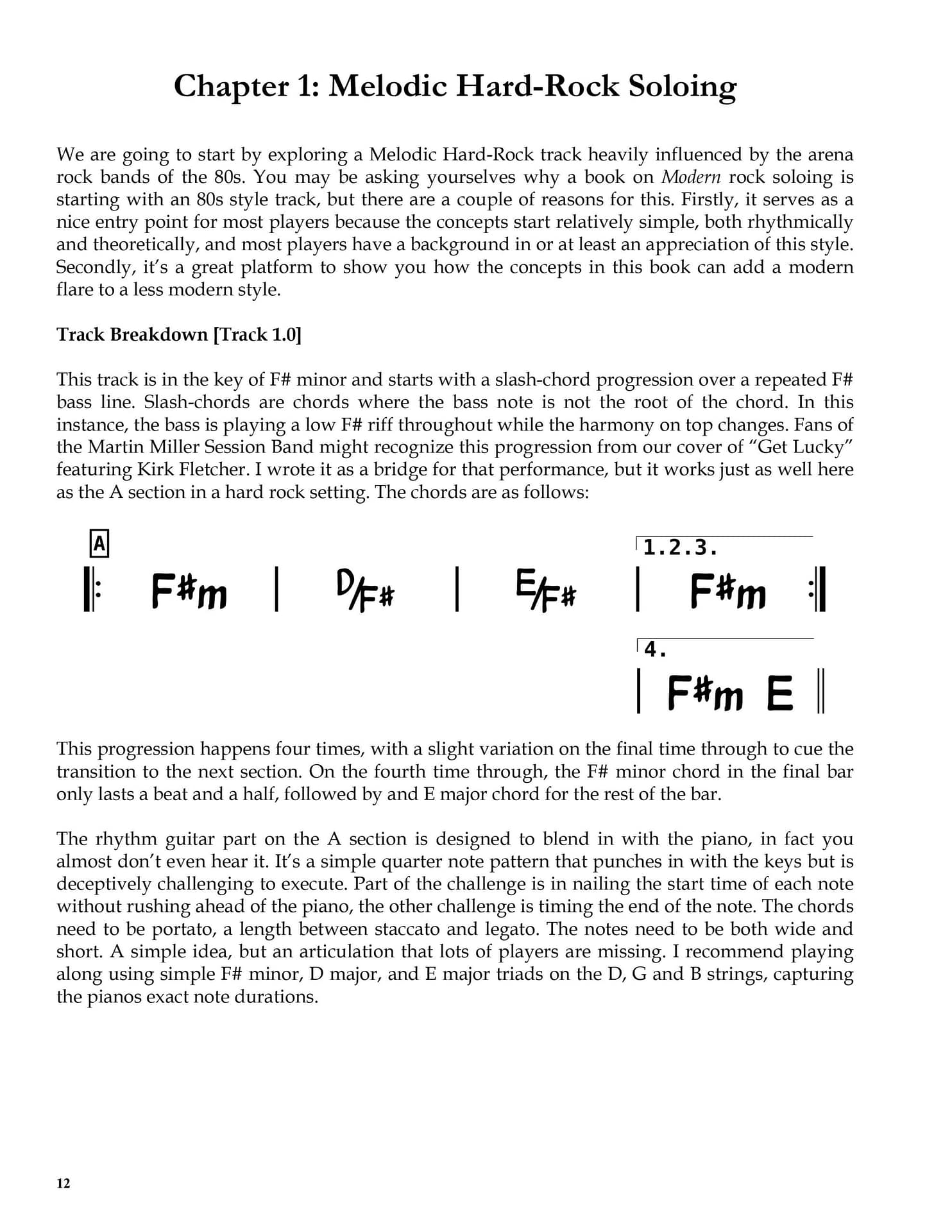
Chapter 1: Melodic Hard-Rock Soloing
You will learn to solo over an 80s-inspired melodic hard-rock track in F# minor, exploring slash-chord progressions and how classic rock vocabulary can be given a modern edge. You will master five signature licks drawing on techniques from players like Carl Verheyen, Steve Morse, and Yngwie Malmsteen. You will develop both an intermediate and advanced solo, gaining hands-on experience with rhythmic motifs, chromatic enclosures, RDAP picking, and chord-tone targeting across a full 32-bar form.
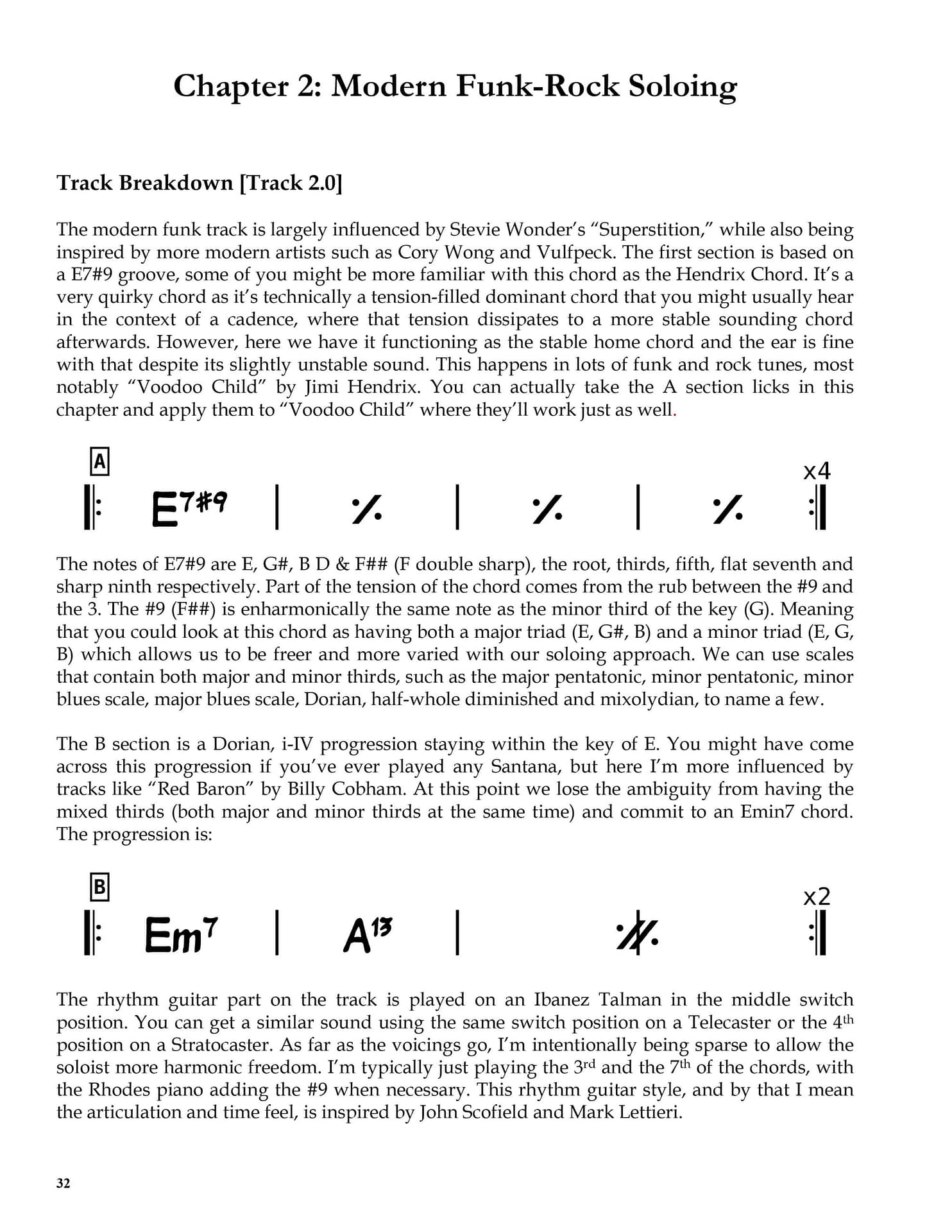
Chapter 2: Modern Funk-Rock Soloing
You will explore soloing over a funk-rock track rooted in a dominant 7#9 "Hendrix chord" vamp, learning how to navigate the chord's unique major-minor ambiguity. You will master the half-whole diminished scale, symmetrical triad shifting, and polyrhythmic sequencing through five signature licks inspired by Scott Henderson, Mike Stern, and Cory Wong. You will achieve fluency in both intermediate and advanced solo contexts, applying concepts like dominant superimposition, off-beat accentuation, and descending triad sequences to craft deeply musical funk lines.
Chapter 3: Emotive Blues-Rock Ballad Soloing
You will learn to solo expressively over a blues-pop ballad in C# minor that fuses the feel of John Mayer and Pink Floyd, developing deep command of phrasing, dynamics, and articulation. You will master techniques including reiteration bends, pentatonic-plus-nine runs, chromatic Django-style licks, and left-right pentatonic sequencing through five detailed signature licks. You will achieve an advanced level of musical storytelling across both sections of the track, learning how to outline diminished chords, target bVI chord tones, and shape a solo with intention and emotional arc.
Chapter 4: Contemporary Rock Soloing
You will learn to navigate one of the most common progressions in modern rock and pop (I-V-vi-IV) in the style of Andy Timmons and U2, including how to handle the chromatic diminished substitution chord and the challenging iv minor chord. You will master five signature licks featuring tetratonics, intervallic double-stops, single-string expression, pentatonic cascades, and melodic minor runs. You will achieve a sophisticated soloing approach across both intermediate and advanced solos, developing skills in meta soloing, distinct-note targeting, anticipations, and G melodic minor application.
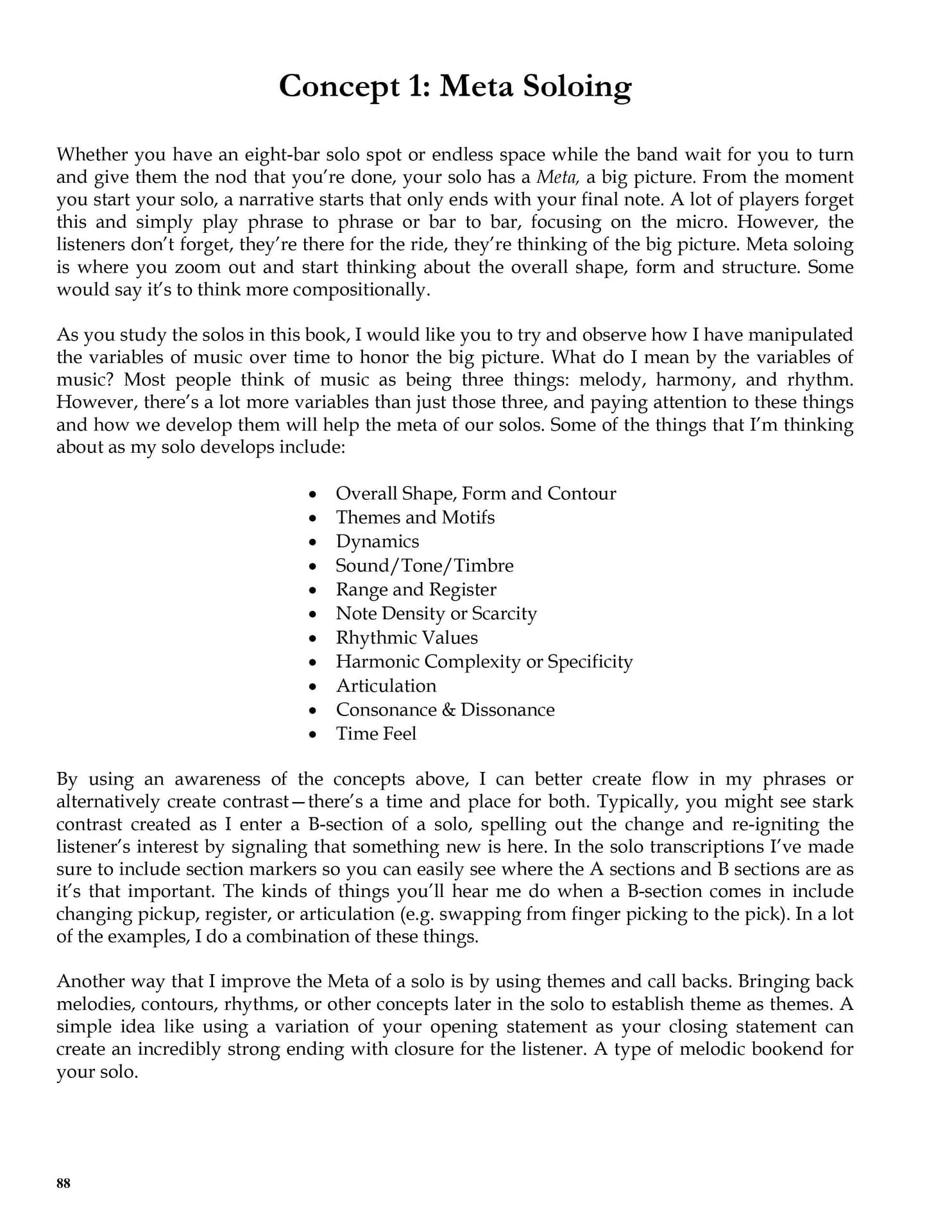
Concept 1: Meta Soloing
You will learn to think about your solos as complete compositions with a beginning, middle, and end rather than just a series of disconnected phrases. You will master how to manipulate musical variables — including register, dynamics, note density, articulation, and harmonic complexity — to shape the overall arc of your improvisation. By studying how themes, call-backs, and section contrasts work across a full solo, you will achieve the ability to craft performances that feel intentional, memorable, and deeply musical to the listener.
Concept 2: Rhythmic Motifs
You will learn how a simple repeated rhythm can become the backbone of an entire phrase or solo, giving your improvisation continuity, hooks, and a sense of purpose. You will study how rhythmic cells are developed, embellished, and varied across musical examples to keep lines fresh without losing their identity. By applying rhythmic motifs to your own playing, you will achieve a new level of compositional discipline and stylistic consistency that transforms your soloing from random notes into memorable music.
Concept 3: Melodic Sequencing
You will learn how to take a short melodic shape and move it diatonically, chromatically, or through octaves to create fluid, hook-filled lines that feel both logical and exciting. You will study sequencing applied to pentatonic scales, seven-note scales, and arpeggios, seeing exactly how the pattern is maintained while the notes shift. By mastering melodic sequencing, you will achieve the ability to generate a seemingly endless supply of cohesive material from just a handful of notes, transforming simple ideas into sophisticated, memorable licks.
Concept 4: Inverse Sequencing
You will learn how to disguise the predictability of melodic sequences by moving each repetition in the opposite direction of the sequence's own contour, creating a forward momentum that sounds far bigger than the underlying idea. You will master how descending sequences can be started from progressively higher points — and vice versa — to produce a compelling two-steps-forward, one-step-back effect. By adding inverse sequencing to your toolkit, you will achieve lines that cover a wide melodic range while maintaining a tight, purposeful structure reminiscent of Eric Johnson, Joe Bonamassa, and Eric Gales.
Concept 5: Variation Techniques
You will learn a suite of melodic variation techniques — including the "happy birthday strategy," rhythmic augmentation, melodic displacement, inversion, and retrograde — that allow you to extract maximum musical mileage from a single phrase or idea. You will master how repeating a melody with a different ending, altered rhythm, or shifted register keeps solos fresh while maintaining thematic unity. By applying these variation tools, you will achieve the ability to build entire solos from minimal raw material, just as the greatest players in rock, blues, and beyond consistently do.
Concept 6: Pedal Notes
You will learn how a repeated or sustained note can serve as a melodic anchor while a second voice moves above or below it, creating a compelling call-and-response texture within a single guitar line. You will master both lower and upper pedal note applications, seeing how this classical concept integrates naturally into rock, blues, and hard-rock soloing. By incorporating pedal notes into your playing, you will achieve more sophisticated and layered-sounding phrases that stand out dramatically from standard single-note runs.
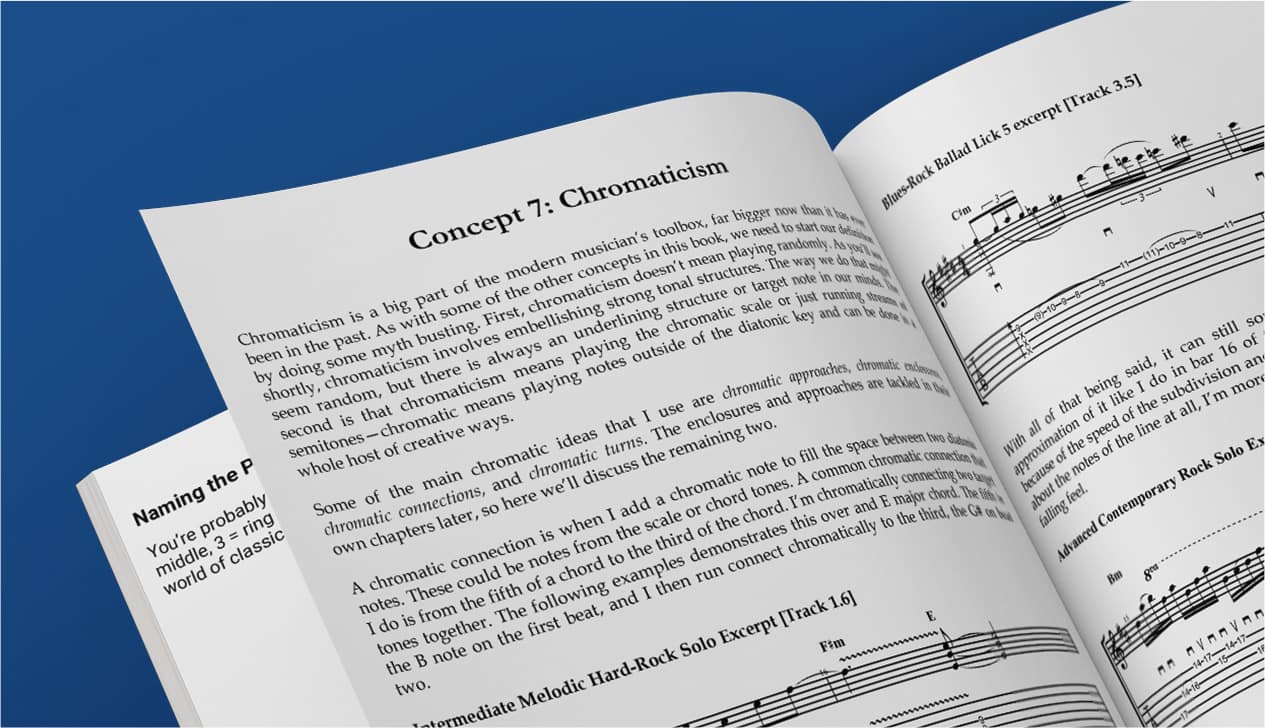
Concept 7: Chromaticism
You will learn that chromaticism is not about playing randomly, but about embellishing strong tonal structures with notes outside the diatonic key through chromatic connections, turns, and cascading runs. You will master how to connect chord tones chromatically, how to ornament a target note with chromatic turns in the style of Django Reinhardt, and when to use flowing chromatic passages for dramatic effect. By developing your chromatic vocabulary, you will achieve lines that sound harmonically sophisticated, modern, and expressive across a wide range of rock and blues styles.
Concept 8: Rhythmically Dependent Alternate Picking (RDAP)
You will learn RDAP, a picking system that aligns downstrokes with downbeats and upstrokes with upbeats, tethering your picking hand to the rhythmic pulse of the music at all times. You will master how to maintain this system even through legato passages by performing ghost strokes that keep the picking motion locked in without touching the string. By ingraining RDAP into your technique, you will achieve a reliable sense of rhythmic accuracy and groove that allows you to improvise confidently at any tempo without losing your place in the subdivision.
Concept 9: Off-Beat Accentuation
You will learn how emphasizing upbeats over downbeats creates an irresistible sense of syncopation, groove, and forward motion in your lead playing. You will master the technique of picking upbeats while slurring into downbeats so that the accent pattern is created naturally and consistently without relying on pure dynamic control. By developing off-beat accentuation, you will achieve a funkier, more sophisticated feel in your soloing that elevates even simple pentatonic lines into something that truly grooves.
Concept 10: Chord Tone Soloing
You will learn the true meaning of chord tone soloing — using chord tones as melodic targets and anchor points rather than as rigid patterns to run up and down — and understand how it differs fundamentally from key-center playing. You will master how to weave chord tones naturally into your lines, targeting even a single note from a chord to give your phrases harmonic relevance and sophistication. By developing your chord tone awareness, you will achieve the kind of melodic specificity heard in players like Robben Ford, Steve Morse, and Pat Metheny, where every line feels connected to the underlying harmony.
Concept 11: Sticking the Landing
You will learn how ending a phrase on a chord tone — regardless of what came before — is one of the most powerful and immediately applicable ways to add harmonic accuracy and sophistication to your soloing. You will master how this technique allows you to use familiar key-center licks and even atonal ideas, while still sounding deliberate and musically grounded as each chord changes. By developing the habit of sticking the landing, you will achieve a more polished and intentional sound that makes even wild outside passages resolve convincingly and musically.
Concept 12: Targeting Tones Within Lines
You will learn how to go beyond simply starting and ending phrases on chord tones by weaving harmonic check-ins throughout entire melodic lines, creating a sophisticated sound that constantly reflects the underlying harmony. You will master how to build lines where every downbeat — or key structural point — lands on a chord tone of the current chord, while scale tones and passing notes fill the spaces in between. By developing this skill, you will achieve long, flowing improvisational lines that feel simultaneously free and deeply harmonically intentional.
Concept 13: Approaches
You will learn how to melodically introduce chord tones from a single direction — using either diatonic scale steps or chromatic half-steps — to create smooth, purposeful arrivals at your target notes. You will master both single-note and multi-note approaches, seeing how the length and color of the approach can dramatically change the character of the arrival. By integrating approaches into your playing, you will achieve more intentional and harmonically connected lines that guide the listener's ear naturally to the most important notes in each chord.
Concept 14: Enclosures
You will learn how to surround a target note with notes from above and below — diatonically or chromatically — to create the sophisticated, jazz-influenced sound of enclosures that make your chord-tone targeting sound deliberate and refined. You will master single, double, and triple enclosures, understanding how the complexity and direction of the enclosure shapes the tension and release leading into the target note. By adding enclosures to your vocabulary, you will achieve melodic lines that outline the harmony with a level of precision and elegance that immediately elevates your playing.
Concept 15: Suspensions
You will learn how to deliberately delay harmonic resolution by emphasizing a non-chord tone — typically a second or fourth — on a chord change before resolving to a stable chord tone, injecting controlled tension into your melodic lines. You will master how to prepare suspensions with approaches or enclosures so they sound intentional rather than accidental, and how to use suspended arpeggios for a modern intervallic sound. By incorporating suspensions, you will achieve a more compositional and expressive soloing style where tension and release are tools you consciously wield.
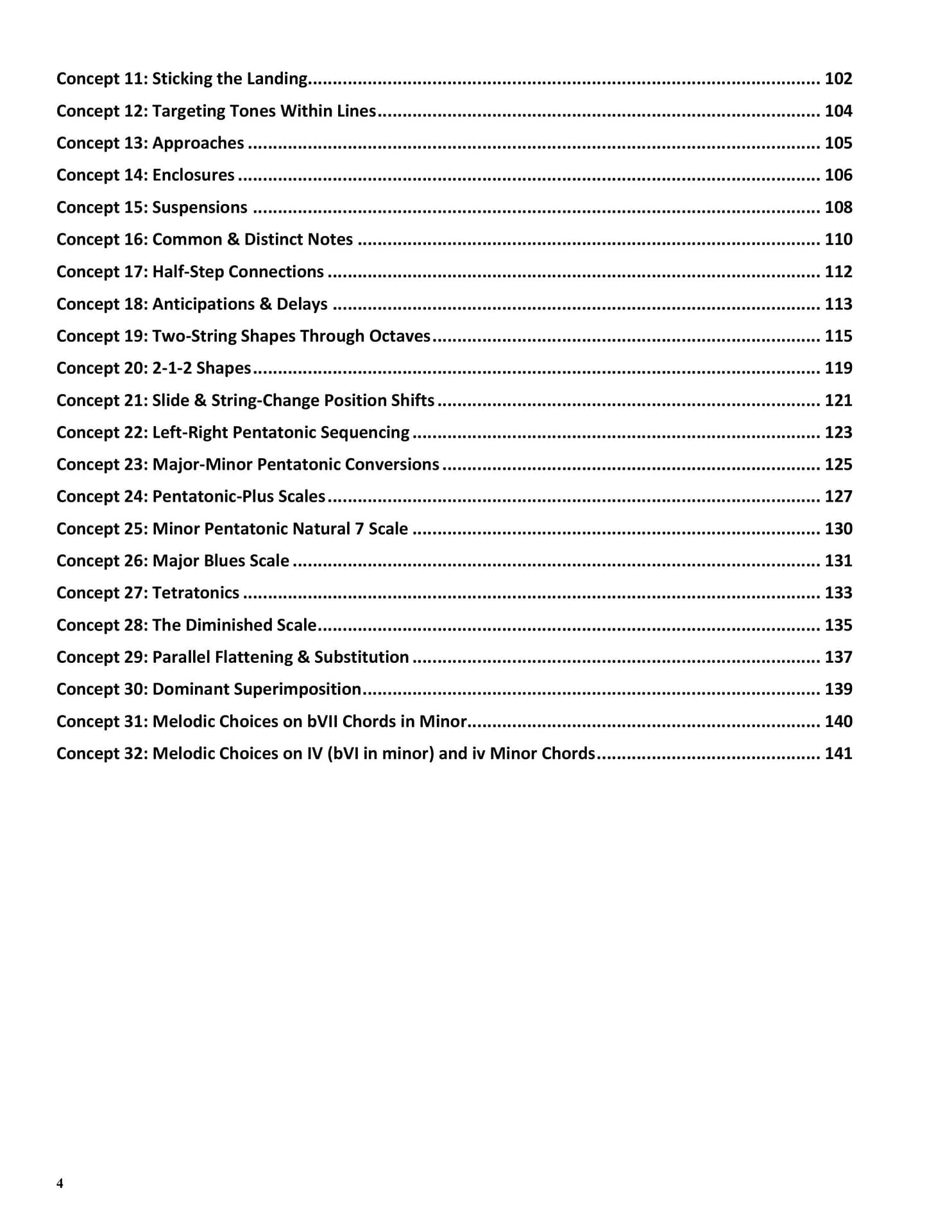
Concept 16: Common & Distinct Notes
You will learn how to analyze the relationship between consecutive chords by identifying which notes are shared (common tones) and which are new (distinct tones), and how to use this knowledge to craft lines that expressively highlight harmonic movement. You will master how targeting distinct tones emphasizes chord changes while leaning on common tones creates a smoother, more connected feel across progressions. By developing awareness of common and distinct notes, you will achieve a deeper harmonic sensitivity that allows you to sculpt every phrase around the character and direction of the underlying chords.
Concept 17: Half-Step Connections
You will learn how voice-leading — specifically the movement of notes by half-steps between chords — can be used to create the smoothest and most satisfying harmonic transitions in your solos. You will master how to identify half-step connections between chords in a progression and then target those melodic movements to give your lines a refined, almost composed quality. By incorporating half-step connections, you will achieve transitions between chords that feel inevitable and elegant, adding a level of harmonic craft to your improvisation that sets it apart from purely scale-based playing.
Concept 18: Anticipations & Delays
You will learn how rhythmically displacing your target tones — either arriving early (anticipation) or late (delay) — creates powerful tension and release effects that add drama and sophistication to your phrasing. You will master how anticipating a chord change creates a sense of forward momentum and superimposition, while delaying resolution produces a satisfying delayed-gratification effect similar to a suspension. By developing control over anticipations and delays, you will achieve a more dynamic and expressive sense of time that makes your phrases feel alive and unpredictable rather than metronomically predictable.
Concept 19: Two-String Shapes Through Octaves
You will learn how to use the guitar's natural octave layout to transpose any two-string melodic shape through multiple octaves while keeping the same physical fingering, enabling effortless fretboard traversal and consistent articulation. You will master how this simple but powerful visualization system applies to tetratonics, arpeggios, pentatonic patterns, and more, giving you a practical way to sequence ideas across the full range of the instrument. By integrating two-string octave shifting into your playing, you will achieve the ability to build large, sweeping lines that cover the entire neck in a natural and musically coherent way.
Concept 20: 2-1-2 Shapes
You will learn the 2-1-2 note-distribution method — alternating between two notes and one note per string — which creates wide intervallic structures that are both fast to execute and distinctively modern in sound. You will master how 2-1-2 patterns are derived from scales and arpeggios, and how they lend themselves naturally to economy picking and sweep-legato hybrid articulations for a fluid, seamless feel. By adding 2-1-2 shapes to your technique, you will achieve the kind of open, intervallic sound associated with players like Tom Quayle and Tim Miller that elevates standard scale playing into something far more sophisticated.
Concept 21: Slide & String-Change Position Shifts
You will learn how to combine a slide with an immediate string change to shift positions on the fretboard smoothly and musically, avoiding the choppy box-to-box sound that plagues many guitarists' attempts at full-neck playing. You will master how this technique can be chained together multiple times to traverse four or more pentatonic positions in a single continuous phrase without any awkward jumps or pauses. By developing the slide and string-change shift, you will achieve the effortless, free-ranging fretboard fluency that makes great players appear to move across the neck without even thinking about it.
Concept 22: Left-Right Pentatonic Sequencing
You will learn to think of the two notes on each string of a pentatonic shape as "left" (closer to the nut) and "right" (closer to the bridge) notes, and use creative alternating patterns between them to generate fresh, unexpected licks directly from the physical layout of the guitar. You will master how left-right patterns naturally flow across multiple pentatonic boxes and positions, making them powerful tools for melodic sequencing that don't require thinking about target notes in the traditional way. By developing left-right pentatonic vocabulary, you will achieve a new source of original lick ideas that have a modern, angular sound while remaining deeply rooted in familiar shapes.
Concept 23: Major-Minor Pentatonic Conversions
You will learn how the same physical pentatonic shape on the fretboard serves as both a minor and a major pentatonic scale simultaneously, and how switching your mental interval map between the two allows you to make far more harmonically relevant melodic choices as chords change beneath you. You will master how to flip between visualizing C# minor pentatonic and E major pentatonic over the same shape, targeting chord tones appropriate to whichever harmony is currently sounding. By developing pentatonic conversion fluency, you will achieve a level of harmonic awareness within familiar scale shapes that dramatically improves the sophistication and musicality of your improvisation.
Concept 24: Pentatonic-Plus Scales
You will learn how adding a single note — specifically the ninth — to the minor pentatonic scale creates a six-note "pentatonic-plus" scale with a distinctly modern and colorful sound used by players like SRV, David Gilmour, and Andy Timmons. You will master multiple positions of the minor pentatonic plus nine in the key of C# minor and learn why the added ninth is harmonically stable and extremely useful for targeting the v and bVII chords in minor-key progressions. By adding pentatonic-plus scales to your palette, you will achieve a richer, more expressive melodic language that goes beyond the standard five-note box without requiring a complete overhaul of your existing vocabulary.
Concept 25: Minor Pentatonic Natural 7 Scale
You will learn how raising the flat seventh of the minor pentatonic scale to a natural seventh creates a powerful five-note structure that aligns with both the Harmonic and Melodic Minor scales, unlocking the sound of Phrygian Dominant and the altered scale from a familiar fingering. You will master how to apply this modified pentatonic over diminished substitute chords and dominant chords to achieve a pseudo-harmonic minor color without having to learn entirely new scale patterns. By developing the minor pentatonic natural 7 scale, you will achieve a practical shortcut to one of the most evocative and sophisticated sounds in modern rock and fusion guitar playing.
Concept 26: Major Blues Scale
You will learn the major blues scale — a major pentatonic with an added flat third — and discover that while few players can name it, virtually everyone has heard its sound in classic rock, country, and blues playing for decades. You will master how to use your existing minor blues scale shapes to access the major blues scale simply by shifting your root note, making it immediately applicable without learning new fingerings. By adding the major blues scale to your toolkit, you will achieve a warm, soulful, and distinctly "un-minor" blues sound that provides a beautiful contrast to minor pentatonic lines and blurs the major-minor divide in all the right ways.
Concept 27: Tetratonics
You will learn how to build four-note scales (tetratonics) by taking the triad of a chord and adding one additional scale tone, creating distinct melodic colors — the 1235, 1345, and 1356 tetratonics — that are more focused and intervallic than full seven-note scales. You will master how to apply these structures to major, minor, dominant, and other chord types, and see exactly how they appear throughout the solos and licks in the book. By incorporating tetratonics into your playing, you will achieve more purposeful note choices that highlight specific harmonic colors with clarity and elegance, giving every phrase a sense of intention that full-scale playing often lacks.
Concept 28: The Diminished Scale
You will learn both forms of the diminished scale — the whole-half and the half-whole (dominant diminished) — with a deep focus on the half-whole version as the go-to color for dominant chords in contemporary rock, funk, and fusion. You will master the scale's symmetrical three-fret repeating structure, which allows any diminished lick, shape, or arpeggio to be moved up the neck in three-fret increments and remain tonally valid. By developing your diminished scale vocabulary, you will achieve the ability to craft ear-bending, tension-filled lines with a modern and sophisticated sound that goes far beyond the usual pentatonic and diatonic options.
Concept 29: Parallel Flattening & Substitution
You will learn how chords a diatonic third apart share all but one note, and how to exploit this relationship either by "flattening" two chords into one simpler scale thought, or by "substituting" a parallel chord structure to add harmonic color and tension to your lines. You will master both techniques in musical contexts — for example, thinking F# minor over both F# minor and D major, or outlining an E major 7 arpeggio over a C# minor chord for added extensions. By developing parallel substitution, you will achieve a more harmonically adventurous sound that introduces color and tension while remaining deeply connected to the underlying chord and key.
Concept 30: Dominant Superimposition
You will learn how to superimpose a dominant seventh — or altered dominant — chord sound a fifth above any target chord in order to create a strong harmonic pull and sense of forward resolution in your improvisation. You will master how to identify the dominant of any chord in a progression and then introduce dominant 7 arpeggios, scales, or structures before that chord arrives to build tension that resolves itself naturally when the band catches up. By adding dominant superimposition to your harmonic toolkit, you will achieve a jazz-influenced level of harmonic sophistication that makes your lines feel purposeful, directional, and richly connected to the underlying progression.
Concept 31: Melodic Choices on bVII Chords in Minor
You will learn why the bVII chord in a minor key requires specific melodic awareness — particularly the importance of avoiding its flat seventh interval, which would create an unwanted dominant sound and undermine the chord's harmonic role. You will master the two most effective scale approaches for the bVII chord: the major pentatonic of that chord and the minor pentatonic plus nine of the home key, both of which emphasize the chord tones without introducing problematic tensions. By developing targeted melodic thinking for the bVII chord, you will achieve cleaner, more musically appropriate lines on one of the most common harmonic movements in rock and minor-key improvisation.
Concept 32: Melodic Choices on IV (bVI in minor) and iv Minor Chords
You will learn why avoiding the root of the IV chord — and instead targeting the seventh or ninth — produces a far more colorful and elegant melodic sound, and why G melodic minor is the ideal scale choice for the iv minor chord in a major-key context. You will master how the home key's pentatonic scale naturally removes the root of the IV chord for you, making sophisticated melodic choices accessible without complex theoretical gymnastics. By developing these specific melodic strategies for IV and iv minor chords, you will achieve a noticeably more refined and expressive sound on two of the most commonly encountered harmonic moments in all of pop, rock, and blues music.
COMMON QUESTIONS
Everything you need to know
Is this course for beginners, intermediate, or advanced players?
This guide is designed for intermediate to advanced guitarists who have some familiarity with lead playing but want to expand their vocabulary and creative approach to soloing. The progressive structure ensures a clear path from foundational concepts to more complex techniques.
Does the book come with audio and video files?
Yes, both the digital and physical versions of the book include access to a complete set of supplemental materials. This includes all audio, video masterclasses (over 6 hours!), and Guitar Pro files for every example, lick, and solo, making it a complete multimedia course.
What’s the difference between the PDF and the paperback version?
The primary difference is the format. The PDF is a digital-only version that you can view on any device. The paperback is a physical, printed book. Both versions include identical content and grant you the exact same access to all accompanying audio, video, and Guitar Pro files.
How do I access the bonus video masterclasses?
Instructions for accessing all bonus content and media files are provided inside the book. You’ll find a URL that directs you to a private, members-only page where you can download or stream all the included resources.
Is the content applicable to just modern rock?
While the book focuses on modern rock soloing, the concepts, licks, and techniques taught by Martin Miller are rooted in fundamental musical principles. They can be applied to a wide range of genres, including jazz, fusion, metal, and blues, making this a versatile resource for any guitarist.

MEET YOUR INSTRUCTOR
Martin Miller
An acclaimed guitarist and solo recording artist, Martin Miller is a highly respected figure in the modern music world. Known for his versatility and technical precision, he is a prominent educator and composer, as well as the bandleader for the "Martin Miller Session Band," whose creative covers have garnered millions of views online. A collaborator with a host of world-renowned guitarists, his passionate approach and innovative playing have solidified his reputation as a leading voice and role model for aspiring musicians everywhere.
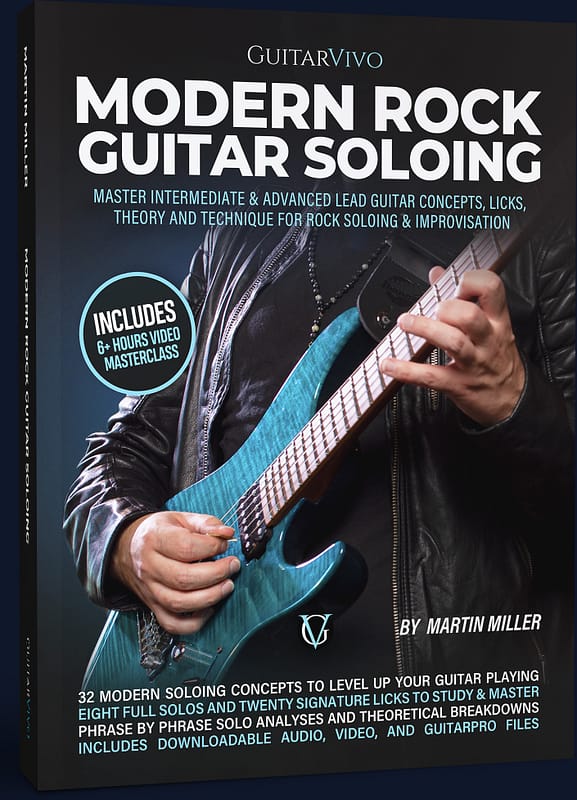
LEVEL UP YOUR LEAD PLAYING WITH
Modern Rock Guitar Soloing
By Martin Miller